
Life Sentence #6
A weekly series, in which I post a single sentence of more than 500 words

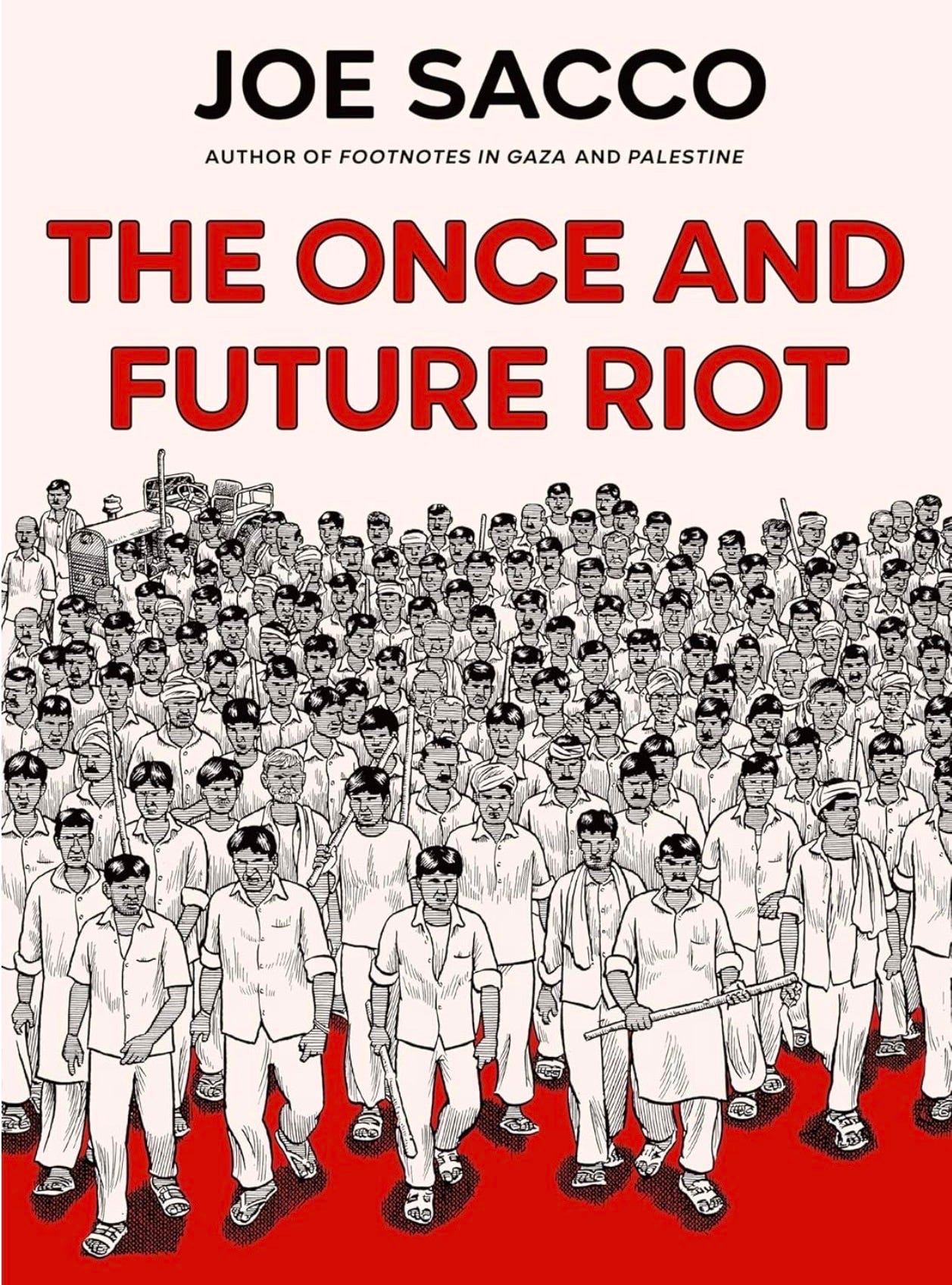
Provided no new terrors have been visited upon the populace, it is a subtle satisfaction for a small-towner-in-exile to see their small town mentioned in the news, and this holds even when the reason has to do with old terrors, for why shouldn’t the world pay attention to the big wrongs of my small corner of the world, and this was the case when I read that Penguin India had chickened out of publishing Joe Sacco’s The Once and Future Riot, a graphic non-fiction book about the Muzaffarnagar riots of 2013, and found in the report the jaundiced delicacies that a legal review of such a book in such a time is bound to bring up, including an aversion to publishing a direct quote from an interview, and a couple of days later, my eyes roving over an excerpt from the Sacco book that an outlet had managed to publish, my mind, untrammelled, though only about as intentional as addled eggs, went to a childhood scene in which I was in primary school and somehow felt the need, out of a vague irritation that might have been incepted on the playground, to call Mohammad Wasim, a classmate, “Mussalman ka bachcha,” fully intending the delivery of an insult through plain fact, and Mohammad Wasim, his face showing the registration of an offence, duly called me “Hindu ka bachcha,” and added—for who could be satisfied with that uninspired tit-for-tat rejoinder to an unwarranted attack—the threat of reporting the matter to our teacher, who, as memory provides readily, was due to appear in the class in a few minutes, minutes which became full of a mortal fear for me, for what I had done was a fresh category of childhood malfeasance, one that I had never seen a teacher deal with before, and which therefore brought forth the dread of an unprecedented punishment, and so, thinking frantically of ways of escaping the dire things to come, I decided to assert, as vehemently as my accuser was bound to, that it was I, not him, who was the first recipient of the insult, that whatever had been said by me was mere repartee, that things had been going on like this for a while, and though this strategy felt sound I also realised that executing it would require a performance from me, whereas the conviction that truth brings—even as a child I knew it brought some—would be enough for Mohammad Wasim, and so it follows that I was sweating bullets when the teacher entered, that my joined palms were shaking as we began to sing “O my lord, I give you all,” that I was trying hard not to look back over my right shoulder and tender a gesture of pure pleading to Mohammad Wasim, who would also at that moment be standing with folded hands and singing “in the love of thee, give me the grace to do it well,” the irony of singing a prayer of this origin and meaning in this particular mess as lost on him as it was on me, and in the next moment, with the musicality of a collective “amen” ending the prayer, the whole class sat down on the wooden benches, the hour began in trademark tedium, books were opened, and Mohammad Wasim—for reasons that remained unknown and smouldered as a mystery under the uneasy quiet that settled between us for the next decade or more—did not complain about me to the teacher, and as I wondered once again, this time while scrolling through Sacco’s busy black-and-white pages, if Mohammad Wasim had read my mind and its treacherous intent, and simply saved himself the trouble of sparring with a common bigot, I had the urge to cover my face with my hands.
***
Oh how faraway and quaint our childhood seems as compared to the ugly brutality of what kids face today! Really took me back Tanuj!